
St. Anne's Ladies Guild
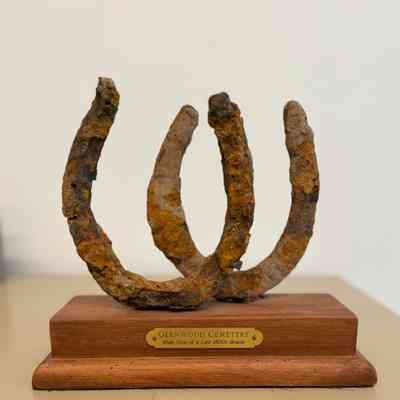
1800s Hearse Mule Shoes
The artifact consists of a set of heavily oxidized iron mule shoes, mounted on a custom wooden display base. A brass plaque identifies it as "Glenwood Cemetery – Mule Shoe of a Late 1800s Hearse." These mule shoes are believed to have belonged to a draft mule used to pull funeral hearses in Glenwood during the late 19th century. They were discovered during construction work at the cemetery. The curvature and dimensions of the shoes are consistent with typical examples from that era, designed for draft animals that towed heavy carriages and processional vehicles.
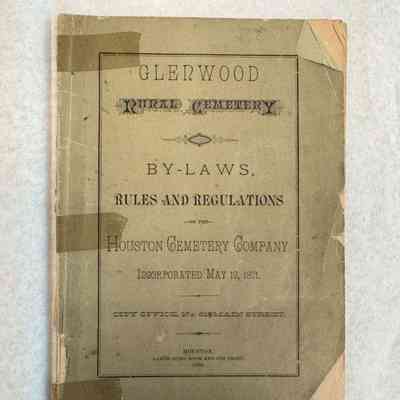
1871 Glenwood Rural Cemetery By-Laws, Rules and Regulations of The Houston Cemetery Company
This printed booklet outlines the foundational regulations governing Glenwood Cemetery, originally known as the Houston Cemetery Company, which was incorporated on May 12, 1871. It includes rules regarding lot ownership, maintenance, interments, and board operations. The pamphlet is printed in black ink on beige paper and exhibits signs of wear, including tape repairs and torn corners, suggesting its use in administrative settings during the late 19th century. As one of the earliest governing documents of Glenwood, this booklet serves as a historical record of cemetery management practices during the Victorian era, reflecting the broader rural cemetery movement that aimed to integrate landscape design with civic organization. It is considered one of the oldest administrative records in the Glenwood Cemetery Archives.
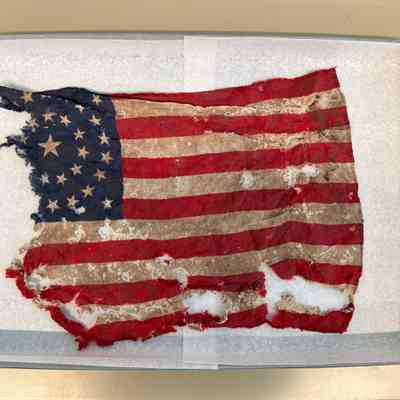
1877 Concentric Circle Designs Flag
In September 2023, the flag was found inside a honeybee tree located in Section H-1 of the cemetery. While its authenticity hasn't been confirmed yet, it has been lodged in the tree for quite some time. The flag was located in a beehive during the extraction of honeycombs, following the tree's split and fall the previous autumn. The tree's natural antibacterial and moisture-reducing properties played a crucial role in preserving the flag over the years. The flag exhibits significant deterioration, characterized by frayed edges, discoloration, and a noticeable loss of fabric integrity, resulting from prolonged exposure. It is believed that the flag was placed at the grave of a veteran buried in Glenwood, as several veteran graves are nearby. Notably, the flag features one of the Concentric Circle Designs from 1877, showcasing 38 stars, a design widely popular during the Civil War and into the late 1800s.
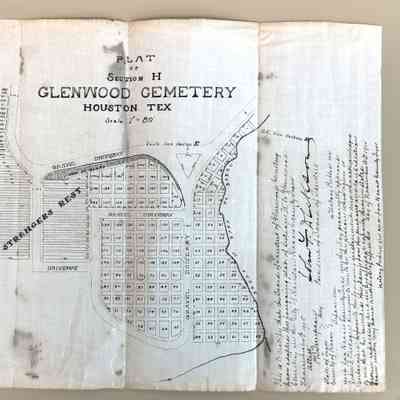
1905 Plat of Section H of Glenwood Cemetery
The document contains a plat map dated November 24, 1905, for Section H of Glenwood Cemetery in Houston, Texas. It is certified by John F. Dickson, the President of the Glenwood Board of Trustees. The inscription on the map reads: "This is to certify that the Board of Trustees of Glenwood Cemetery has adopted the following plot of Section H in Glenwood Cemetery, located in the City of Houston Harris County Texas on November 24, 1905. John F. Dickson President of the Board of Trustees." Additionally, there is an inscription indicating that a notary public served as a witness to the certification of this plot.
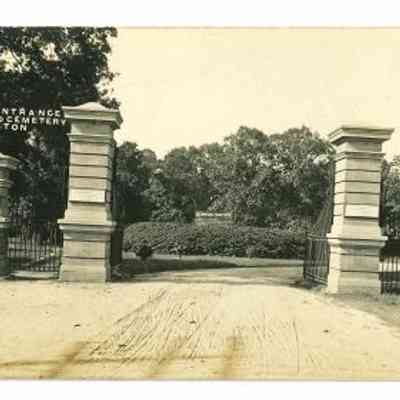
1907 Original Postcards of Glenwood Cemetery
This collection of 1907 photographic postcards provides visual documentation of Glenwood Cemetery in Houston, Texas. The images present key elements of the cemetery's design and landscape, including: - Main Entrance - Allen 1081 - Main Drive Way - Allen 1082 - Park Fronting Washington Avenue with Res of Supt - Allen 1083 - Entrance to Glenwood Cemetery from Park Fronting Washington Ave - Allen 1084 - Looking North from the Office - Allen 1085 - Looking East through Glenwood Cemetery - Allen 1087 - Office of Glenwood Cemetery - Allen 1088 - The Bayou As It Passes Through Glenwood Cemetery - Allen 1089 - In The New Additions - Allen 1089 - A Shady Lane - Allen 1090 - Approach to Glenwood Cemetery from Kane St. Entrance - Allen 1091 - Kate St. Entrance to Glenwood Cemetery - Allen 1092 Each postcard includes printed captions that describe the scenes and prominently feature the name "Allen" in its typography. The cards were never mailed, suggesting they were likely created for local sale, tourism, or promotional purposes.
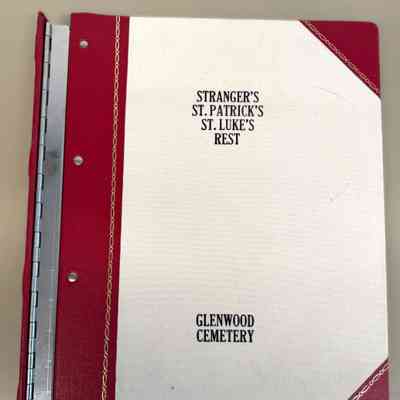
Internment Book for Sections Old Strangers Rest, St. Patrick's Rest, and St. Luke's Rests
The Big Book for the Sections of Old Strangers Rest, St. Patrick's Rest, and St. Luke's Rest provides insights into the sequence in which the denominational sections were recorded and developed. Notably, the term "Catholic section" refers to the area on the east side of Glenwood. The earliest burial records identify St. Luke's Rest and St. Patrick's Rest as the Catholic section, with burials beginning in 1887. However, this practice sharply declined after 1904, when Holy Cross, a new Catholic cemetery, opened. The last burial in St. Luke's and St. Patrick's Rest at Glenwood occurred in 1915. This suggests that the area may have been designated as the Catholic section because it served as a burial site for Catholics between the closure of St. Vincent's Cemetery and the opening of Holy Cross.